

Tendon Stiffness Troubleshooting: ECM Causes and Fixes

Overview: what tendon stiffness looks like and what it usually signals

Tendon stiffness is one of those symptoms that can feel “mechanical” but originate from tissue biology. People often notice a tendon that feels tight, resists stretch, or produces early discomfort when moving into end ranges. In training contexts, stiffness may appear as reduced tendon glide, a sense of “binding,” or a rapid warm-up followed by persistent limitation. In clinical contexts, patients may report pain that increases with loading, morning stiffness, or a feeling that the tendon does not “spring” back as it should.
Because tendons transfer force from muscle to bone, stiffness affects both performance and comfort. It can show up even when pain is mild—especially when the tendon’s ability to deform elastically and recover is reduced. A key point for tendon stiffness troubleshooting is that the tendon’s extracellular matrix (ECM)—the collagen network, proteoglycans, water content, and cross-linking environment—strongly influences mechanical behavior. When ECM properties shift toward a stiffer, less adaptable state, the tendon often behaves like it has “lost its spring.”
This article focuses on tendon stiffness troubleshooting ECM causes: how to recognize the patterns that point to ECM-driven stiffness, how to work through a step-by-step process to reduce it, and when to escalate to professional evaluation or consider replacement-level interventions.
Most likely causes: ECM changes that increase tendon stiffness
When tendon stiffness is driven by ECM, the problem is rarely a single factor. Instead, it’s typically a combination of altered loading, impaired remodeling, and tissue environment changes that shift collagen organization and matrix hydration.
1) Collagen cross-linking and reduced remodeling flexibility
Collagen in healthy tendons remodels in response to appropriate loading cycles. If remodeling is slow or biased toward more rigid cross-links, the tendon can become less compliant. This can be influenced by age-related changes, chronic overuse patterns, incomplete recovery, and periods of underloading that reduce the stimulus for normal ECM turnover.
2) Collagen disorganization and “stiff scar-like” ECM
After microtrauma (from training spikes, awkward mechanics, or repetitive strain), the ECM may heal with altered collagen alignment. Even when the tendon is not visibly torn, the ECM can become more rigid due to a scar-like organization. In stiffness troubleshooting, this often presents as limited tendon glide, persistent tightness, and pain that may be triggered by load progression rather than by end-range stretching alone.
3) Persistent inflammatory signaling and altered matrix hydration
ECM stiffness is partly related to water content and proteoglycan behavior. If inflammatory signaling persists, the matrix environment can shift, affecting hydration and viscoelastic properties. The tendon can feel “stuck” or hard, and symptoms may fluctuate with activity levels.
4) Tendon overload or insufficient load variation
Overload can drive ongoing microdamage and maladaptive remodeling. On the other hand, too little loading (or loading that is too monotonous) can also impair ECM turnover. Tendons need progressive, well-tolerated mechanical stimulus to remodel toward optimal compliance. When the stimulus is missing or excessive, stiffness can increase.
5) Mechanical contributors that indirectly stiffen the ECM
ECM changes don’t happen in isolation. If the surrounding tissues are stiff—fascia, muscle-tendon units, joint capsules—or if movement patterns restrict tendon excursion, the tendon experiences altered strain distribution. That can promote ECM adaptation in the direction of stiffness. Examples include limited ankle dorsiflexion affecting Achilles loading or hip stiffness increasing stress on knee tendons.
Step-by-step tendon stiffness troubleshooting and repair process
Use the following process to narrow down ECM-driven stiffness and reduce it systematically. The goal is to improve tendon compliance while respecting tissue tolerance—because “pushing harder” often worsens ECM rigidity if the underlying driver is still present.
Step 1: Confirm the stiffness pattern and track it
Start with a simple symptom log for 7–14 days. Track:
- Time of day stiffness is worst (morning vs after activity)
- Whether stiffness improves quickly with warm-up or persists
- Whether pain increases during loading (not just stretching)
- How symptoms respond to reduced activity (do they calm down or rebound)
- Any “catching” sensation suggesting tendon glide restrictions
This helps differentiate stiffness driven by mechanical restriction from stiffness driven by ongoing ECM irritation. Consistent worsening with load suggests the tendon is not tolerating the current stimulus.
Step 2: Screen for red flags and stop if needed
Before progressing, rule out urgent issues. Seek professional assessment if you have sudden tendon failure symptoms, rapidly increasing swelling, inability to bear weight, fever, unexplained night pain, numbness/tingling, or a clear deformity. ECM-driven stiffness is common, but these signs can indicate more serious pathology.
Step 3: Identify the current load trigger
List your recent training/work demands: frequency, intensity, and any abrupt changes. Tendons often show stiffness after a “too fast, too much” period, but also after prolonged low activity followed by return to loading. Identify the movement that consistently provokes stiffness or pain.
If you can reproduce stiffness reliably, you can also test whether adjusting that trigger reduces symptoms. This is one of the most direct ways to confirm whether ECM remodeling is being driven by ongoing overload.
Step 4: Reduce the aggravating load without fully unloading
For stiffness troubleshooting ECM causes, the aim is to lower the mechanical irritant while keeping the tendon engaged enough to remodel. A practical approach is to temporarily reduce:
- Volume (total reps/sets or time on feet)
- Intensity (peak loads or faster plyometric work)
- Rate of loading (rapid changes can spike tendon strain)
Replace with lower-irritation options such as controlled, submaximal work within pain-free or near-pain-free ranges. Many people make the mistake of complete rest; complete unloading often increases stiffness by reducing the ECM’s adaptive stimulus.
Step 5: Restore tendon capacity with progressive loading that targets compliance
Next, introduce a structured tendon loading program. The most effective programs usually include:
- Isometric holds to calm pain and improve immediate function
- Eccentric or combined loading to stimulate remodeling
- Progressive isotonic work that gradually increases tendon strain
- Later-stage return to dynamic loading for functional compliance
The key is progression based on symptom response, not calendar time. A tendon that is stiff due to ECM changes often improves when loading is dosed to encourage remodeling rather than inflaming the matrix.
In practice, many people use a heel-raise variation for Achilles or a band-resisted tendon exercise for patellar tendons. For hand/wrist tendons, controlled grip or wrist extension/flexion eccentrics can be used. The exact exercise choice depends on tendon location, but the principle is consistent: load the tendon in a controlled way and progress as tolerated.
Step 6: Add mobility only as tolerated, not as the primary fix
Because stiffness is often ECM-driven, stretching alone may not resolve it. Still, mobility work can support better tendon excursion and reduce compensatory strain patterns.
Use low-to-moderate intensity stretching or joint mobility that does not spike symptoms during or after. If stretching increases pain or stiffness that lasts into the next day, reduce intensity or duration and prioritize loading capacity first.
Step 7: Address matrix irritants: sleep, nutrition, and recovery demands
ECM remodeling is sensitive to recovery quality. Sleep disruption and inadequate nutrition can impair tissue repair. While these factors are not “magic cures,” they influence the environment in which collagen remodeling occurs.
Focus on consistent sleep duration, adequate protein intake, and overall energy balance. If you have medical conditions affecting collagen metabolism (for example, diabetes or chronic inflammatory disorders), professional guidance becomes more important because ECM behavior may not respond as expected to standard loading.
Solutions from simplest fixes to advanced fixes
Work through these options in order. If your tendon stiffness troubleshooting points strongly to ECM-driven rigidity, start with mechanical dose management and tendon loading, then escalate only if symptoms and function do not improve.
Simplest fix: adjust load dose and movement mechanics for 1–2 weeks
Begin with the simplest changes that reduce ECM irritant load:
- Cut training volume by 20–40% temporarily (or more if symptoms are high)
- Avoid sudden speed changes or steep hills/ramps (common stiffness triggers)
- Use supportive footwear or orthotic padding if it reduces painful tendon strain mechanics
- Maintain gentle range of motion within comfort to reduce “protective stiffness”
During this phase, you should see either reduced pain provocation or improved warm-up response. If the tendon feels equally stiff and function is worsening, move to the next step rather than extending rest.
Next step: introduce isometric holds to reduce stiffness sensitivity
Isometrics can be useful when stiffness is accompanied by discomfort during loading. Choose a position that produces a tolerable effort (often around a 4–6 out of 10 discomfort) and hold for 30–60 seconds. Repeat multiple sets with rest between.
For example, Achilles-related stiffness may respond to sustained calf isometric work; patellar tendon stiffness may respond to knee extension isometrics; wrist tendon stiffness may respond to controlled wrist positioning with band tension. Keep technique strict and avoid bouncing.
Isometrics should not be used to “force through” sharp pain. If pain is high, reduce effort and reassess load triggers.
Progression: eccentric or combined tendon loading to reshape ECM
When the tendon can tolerate isometrics, progress to eccentric or combined loading. This is where ECM remodeling is most directly targeted. The goal is to increase tendon strain in a controlled, repeatable manner.
Typical progression includes:
- Start with slow, controlled reps
- Maintain a stable range and avoid end-range forcing
- Increase load gradually as symptoms settle
- Track next-day response to ensure you’re not driving persistent irritation
Some tendons respond well to slower eccentrics; others do better with combined eccentric-concentric work. The best choice is the one that produces consistent improvement without symptom flare-ups.
Target compliance: add controlled dynamic loading once stiffness calms
ECM stiffness often shows up in dynamic tasks—running, jumping, stairs, or quick directional changes. Once basic loading is tolerated, add low-amplitude plyometric or hopping progressions, or sport-specific movement patterns.
Start small. For the Achilles, that might include controlled calf raises to small hops; for patellar tendon, step-down mechanics and controlled jumps; for wrist tendons, progressive grip-to-release patterns. The aim is to restore tendon viscoelastic behavior—its ability to store and release energy—without re-irritating the ECM.
Support tendon glide: address surrounding tissue stiffness and joint mobility
If you notice tendon “binding” or limited glide, the ECM may be reacting to mechanical constraints in adjacent tissues. In that case, incorporate targeted soft tissue and mobility work:
- Gentle tissue mobility for adjacent fascia/muscle groups
- Joint mobility that improves the tendon’s excursion path
- Movement retraining to reduce compensatory mechanics
Be cautious with aggressive techniques that spike symptoms. The intent is to improve movement quality and reduce frictional or positional stress that can reinforce stiff ECM patterns.
Advanced: consider adjunct clinical modalities when progress stalls
If you complete several weeks of appropriate loading and dose management but tendon stiffness remains pronounced—especially with persistent pain, plateaued function, or clear signs of chronic ECM rigidity—professional evaluation is warranted. Clinicians may consider modalities aimed at changing tissue environment and pain regulation, such as:
- Extracorporeal shockwave therapy (often used for chronic tendon conditions)
- Targeted manual therapy and guided rehab for tendon glide restrictions
- Supervised progressive loading programs with precise dosing
- Imaging to assess tendon structure and rule out partial tears or calcific changes
These adjuncts do not replace loading; they are typically used to help the tendon tolerate and respond to remodeling work. If you’re considering these options, choose a clinician who can integrate ECM-focused rehab with objective progression criteria.
Advanced diagnosis: imaging and lab considerations for ECM-driven stiffness
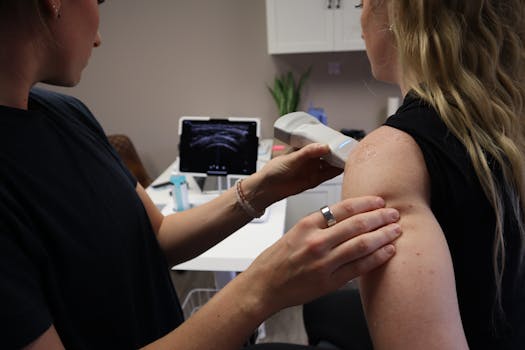
When stiffness troubleshooting ECM causes is difficult to resolve, imaging can clarify whether stiffness reflects structural changes such as tendon thickening, partial tearing, or calcification. Ultrasound or MRI may also help identify surrounding issues (bursitis, synovitis, or entrapment) that keep the tendon environment irritated.
Additionally, consider systemic factors that influence ECM behavior: metabolic disorders, inflammatory conditions, medication effects, and hormonal influences. A clinician can help determine whether those factors are likely contributing to persistent stiffness.
Replacement-level scenarios: when “repair” is no longer sufficient
Replacement or surgical-level interventions are not the first step for tendon stiffness. However, in some situations—such as significant tendon structural failure, irreparable degeneration, or persistent functional loss despite appropriate conservative care—orthopedic specialists may discuss surgical options.
These decisions are based on imaging, functional deficits, and symptom severity. If you have progressive weakness, a visible gap, or inability to perform key tendon-dependent actions, seek professional assessment rather than continuing self-management.
When replacement or professional help is necessary
Professional evaluation becomes necessary when self-directed tendon stiffness troubleshooting does not restore function or when the risk of ongoing ECM damage is high.
Seek professional help promptly if any of these apply
- You suspect a partial or complete tendon tear (sudden event, marked weakness, or deformity)
- Pain is severe, increasing, or accompanied by significant swelling
- You cannot perform basic functional tasks that require tendon action (pushing off, gripping, extending, or bearing weight)
- Night pain is persistent or worsening
- Symptoms do not improve after a structured loading and dose-management program over 6–12 weeks
- You have medical conditions that strongly affect healing (for example, uncontrolled diabetes or systemic inflammatory disease)
Consider escalation when ECM-driven stiffness appears chronic
ECM changes can become more rigid over time, particularly when the tendon repeatedly cycles through overload and incomplete recovery. If you’ve progressed through isometrics and tendon loading with good technique but still experience persistent stiffness that limits daily function, the next step is usually a clinician-led plan. Imaging may be needed to verify whether the stiffness is primarily ECM remodeling or whether there is a structural driver that requires different management.
What to bring to the appointment
To make professional care efficient, bring:
- Your symptom log (what worsens stiffness, what improves it, next-day response)
- Details of your loading changes (what you reduced/increased, and when)
- Photos or notes of swelling or visible thickening if present
- List of exercises you tried and how the tendon responded
- Any relevant medical history affecting healing
This information helps clinicians distinguish ECM stiffness patterns from other causes such as nerve involvement, joint pathology, or tendon structural injury.
Guidance on “repair” vs “manage”
For many people, tendon stiffness improves with the right balance of load and recovery. For others, the tendon may never fully return to previous compliance if ECM remodeling has become entrenched or if structural damage is present. In those cases, the goal shifts to restoring function and reducing stiffness sensitivity through long-term management strategies, which may include periodic loading progressions and maintenance mobility.
The most important principle is that ECM-driven stiffness responds best to consistent, tolerable mechanical stimulus. Avoid the extremes of total rest or aggressive stretching without loading capacity. When you see persistent plateau, professional assessment helps determine whether the ECM is still being driven by irritant load, whether structural changes are present, or whether systemic factors are limiting remodeling.
If you’d like, share the tendon involved (Achilles, patellar, rotator cuff, wrist, etc.), how long symptoms have lasted, and what movements provoke stiffness. I can help you map the most likely ECM drivers and outline a progression that matches your situation.
27.11.2025. 00:42